| |
Animals of the World
Water is home to a vast share of animal life, and fish are the most numerous group of vertebrates. They breathe through gills that extract oxygen from water, propel themselves with fins, and are usually covered in protective scales. Fish range from tiny species in streams and ponds to large predators of the open ocean, and they fill many ecological roles as grazers, hunters, and prey.
Amphibians such as frogs, toads, and salamanders bridge water and land. Most begin life as aquatic larvae that breathe with gills and later develop lungs as they mature, allowing the adults to live partly on land while returning to water to breed. Their moist skin plays a part in breathing, which makes them sensitive to changes in their environment and useful indicators of habitat health. The transformation from a gilled larva into an air-breathing adult, known as metamorphosis, is among the most striking life cycles in the animal world.
Beyond fish and amphibians, the animal kingdom includes reptiles, birds, mammals, and a huge variety of invertebrates such as insects and arachnids. Each group has adaptations suited to its way of life, from the camouflage of forest animals to the speed of open-country hunters. Many species today face pressure from habitat loss, and conservation programs work to protect those that are rare or endangered.
Frequently asked questions
- How do fish breathe underwater?
- Fish use gills, which extract dissolved oxygen from water as it flows over them, allowing the fish to breathe without coming to the surface.
- Why do amphibians need both water and land?
- Many amphibians begin life as aquatic larvae and breed in water, while the adults can live on land. Their moist skin also depends on damp conditions.
- Why are amphibians sensitive to their environment?
- Because they breathe partly through their skin and pass through an aquatic stage, amphibians are easily affected by pollution and habitat change, making them useful environmental indicators.
|
|
|
|
|
F 
|
|
 |
|
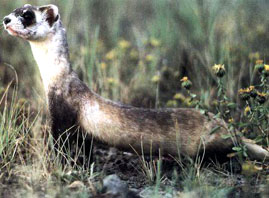
Ferret:
black footed ferret
the black-footed ferret (Mustela nigripes) has been considered the most
endangered mammal in North America for many years
|
|
Ferret:
black footed ferret |
|
Flamingo |
|
Flamingo: Puna
Flamingo long-legged and long-necked wading bird, family
Phoenicopteridae |
| Flamingos
flamingo, family Phoenicopteridae |
| Flatworms
this site is devoted to the study of polyclad flatworms (phylum
platyhelminthes, class turbellaria, order polycladida), a group of large,
free-living marine Platyhelminthes which are mainly found in tropical
coral reefs
|
| Fleas
(siphonaptera)
fleas (order Siphonaptera) are one of the major groups of blood-sucking
insects. They belong to holometabolic insects
|
| Florida
panther
the elusive endangered Florida panther, its habitat and the fascinating
plants and animals that share its southwest Florida home
|
|
Florida
panther |
|
Florida
panther |
|
Fly Drosophila melanogaster (from the Greek for black-bellied dew-lover)
is a dipteran (two-winged) insect |
|
Fly
base drosophila anatomy and images, a tip
|
|
FlyServer an
image database on Drosophila development and genetics, Drosophila
Multimedia Database |
| Fox forest foxes, fox pictures, fox gallery, pictures of foxes, fox images, fox sounds, fox movies
|
|
Foxes foxes, pdf file |
|
Foxes:
red
fox red fox |
|
Frogs |
|
Frogs
Coqui & greenhouse frogs: alien Caribbean frogs in Hawaii, Problematic frogs
trouble people, environment |
|
Frogs
there are close to 4,000 known
species of frogs, including toads. They range in size from less than half an
inch to nearly a foot long and come in a rainbow of colors and patterns |
| Frogs:
African clawed frog facts These frogs are found along the African Rift
Valley south of the Sahara in east and southern Africa. They are also found
in South Africa and Namibia and Angola in western Africa |
|
Frogs: African clawed frog Xenopus laevis, the African Clawed Frog, is
the largest and most widely distributed of its genus. They are originally
from Africa south of the Sahara, pdf file |
|
|
Home
|
Site Map
|
Email: support[at]karadimov.info
Last updated on:
2026-06-24
|
Copyright © 2011-2021 Educypedia.
https://educypedia.org
|
| |
|
|