| |
The digestive system
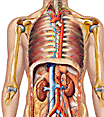
The digestive system is the group of organs that breaks down food into substances the body can absorb and use, and that removes the unusable remainder as waste. It consists of a long muscular tube, the gastrointestinal tract, running from the mouth to the anus, together with several accessory organs that assist digestion. Its work supplies the body with the nutrients and energy needed to grow, repair tissue and function.
Digestion begins in the mouth, where food is chewed and mixed with saliva, then passes down the oesophagus to the stomach. The stomach stores food and secretes acid and enzymes that begin breaking down proteins, churning the food into a semi-liquid mixture. This passes into the small intestine, where most chemical digestion and nutrient absorption take place. Several accessory organs support this stage: the liver produces bile, the gall bladder stores and releases that bile to help digest fats, and the pancreas supplies digestive enzymes along with substances that regulate blood sugar. The large intestine then absorbs water from the remaining material and forms waste for elimination.
Other structures are commonly studied alongside the digestive organs. The appendix is a small pouch attached to the large intestine, while the urinary system, which filters the blood and removes liquid waste, works in parallel to keep the body's internal environment balanced. Disorders of these organs — such as inflammation, infection or obstruction — are an important part of human anatomy and medicine.
Frequently asked questions
- What is the main job of the digestive system?
- It breaks food down into nutrients the body can absorb for energy, growth and repair, and it eliminates the parts that cannot be used.
- What does the liver do in digestion?
- The liver produces bile, which helps break down fats; the bile is stored in the gall bladder and released into the small intestine when needed.
- What role does the pancreas play?
- The pancreas releases digestive enzymes into the small intestine and also produces hormones, such as insulin, that regulate the level of sugar in the blood.
|
|
Digestive system, abdomen  |
|
Abdominal Wall,
Peritoneum Plexuses the abdomen, abdominal cavities, abdominal wall, and
plexes and their structures |
|
Digestion
Anus, Esophagus, Oral Cavity, Appendix, Gall Bladder, Pancreas, Ascending Colon,
Ileum Rectum, Cecum Jejunum, Salivary Glands, Descending Colon, Larynx, Sigmoid
Colon, Diaphragm, Liver, Stomach, Duodenum, Nasal Cavity, Transverse Colon |
|
Digestion A Voyage Through the Digestive Tract, Pregastric Digestion, The
Stomach, The Liver and Biliary System, The Pancreas, The Small Intestine, The
Large Intestine |
|
Digestive system |
|
Digestive system the digestive tract is basically a hollow muscular tube, mucosal epithelium lining the inner
surface, and circular and longitudinal muscle comprising the walls. The mucosa, forming the inner lining of the tract, is supplied with a rich network of blood
vessels, nerve fibres and endocrine cells |
| Digestive system
Anus, Esophagus, Oral Cavity, Appendix, Gall Bladder, Pancreas, Ascending Colon,
Ileum Rectum, Cecum Jejunum, Salivary Glands, Descending Colon, Larynx, Sigmoid
Colon, Diaphragm, Liver, Stomach, Duodenum, Nasal Cavity, Transverse Colon |
| Digestive system |
| Digestive system |
| Digestive system |
| Digestive system simply put, the digestive system
is a portal for nutrients from the environment to gain access to the circulatory
system. Before such transfer can occur, foodstuffs first have to be reduced
to very simple molecules by a combination of mechanical and enzymatic degradation |
| Digestive system
tongue, glands in the mouth that make saliva, pancreas, liver, gallbladder, mouth, esophagus, stomach, small intestine, large intestine, rectum, anus,
pdf file |
| Digestive system
the digestive process is the means by which food taken into our bodies is used to provide us with energy and nutrients needed for growth and renewal, with
anything that is not used expelled as waste. All of this takes place in what is known as the 'gastro-intestinal tract'. This starts at the mouth where food
enters the body and ends at the anus where waste leaves the body. The total length of the digestive tract is an amazing 9 metres,
animation |
| Digestive system
tongue, salivary glands, esophagus, stomach, liver, gall bladder, bile duct, pancreas, pancreatic duct, small intestine, appendix, large intestine, rectum,
anus |
| Digestive system
the main part of the digestive system is the digestive tract. This is like a
long tube, some nine metres in total, through the middle of the body. It starts
at the mouth, where food and drink enter the body, and finishes at the anus,
where leftover food and wastes leave the body |
| Digestive system
printable picture |
| Digestive
system and how it works the digestive system is a series of hollow organs
joined in a long, twisting tube from the mouth to the anus, Digestive
system drawing |
| Het
menselijke verteringsstelsel het verteringsproces begint zodra je voedsel in je mond stopt. Via je mond gaat het naar je keelholte waarna het in je slokdarm terecht komt. In je slokdarm wordt het
eten voortbewogen d.m.v. darmperistaltiek. Als het door je slokdarm heen is dan komt het voedsel in je maag terecht. Je maag fungeert
als een soort magazijn in Dutch |
| Human
digestive system the digestive system contain organs for changing food chemically for absorption by body tissues. It is also responsible for
processing food, breaking it down into usable protein, minerals, carbohydrates and fats and other substance. The digestion process involves breaking food into
simple soluble substances absorbable by tissues |
| Lower digestive system digestion is the process of breaking down and
distributing food throughout the body. The most complex parts of the lower digestive system consist of the pancreas, the small intestine, and the large
intestine. The appendix, the rectum, and the anus are below these organs |
|
Spijsverteringsstelsel
het spijsverteringsstelsel loopt vanaf de mond tot aan de anus. Het is grotendeels een heel lange buis, waarin voornamelijk voedsel in stukken gedeeld
wordt, en waarin voedingsstoffen opgenomen worden in het lichaam, in Dutch |
|
The
digestive system
digestion, stomach, the digestive system includes all the organs and glands involved in this process of eating and digesting. Starting in the mouth, a long
muscular tube provides continual fluid and vital nutrients. The coiled intestines alone are about 24 feet long. After we consume food, the body
mechanically and chemically breaks it down, then transports it for absorption and defecation |
|
Understanding your digestive system pdf file |
| Understanding your digestive system
the digestive process takes place in tubes and sacs that extend from the mouth to the anus, this system being known as the alimentary canal. Its organs are the
mouth, the pharynx, the oesophagus, the stomach, small and large intestines, the rectum and the anal canal |
|
Digestion: miscellaneous topics |
|
Digestive system and nutrition ppt file |
|
Peristalsis
Animation shows how constriction of a tube (esophagus) causes food
particles to be pushed through the tube |
|
Secretion of bile and the role of bile acids in digestion |
|
Digestive system: organs |
|
Digestive System
Liver, gall bladder, pancreas, Oral cavity, salivary glands, stomach, intestines, Skeletal
muscle in the tongue |
|
Large
Intestine the large intestine and its structures |
|
Liver
The liver is the largest gland in the body and performs an astonishingly large
number of tasks that impact all body systems, ... |
| Liver
the liver is an organ in vertebrates including humans. It plays a major role in metabolism and has a number of
functions in the body including detoxification, glycogen storage and plasma protein synthesis |
|
Pancreas |
|
Pancreas
pancreas anatomy, the pancreas is an elongated, tapered organ located across the back of the abdomen, behind the stomach |
|
Stomach
serves as a short-term storage reservoir, allowing a rather large meal to be
consumed quickly and dealt with over an extended period of time |
| Stomach
the main function of the stomach is to process and transport food. After feeding, the contractile activity of the stomach helps to mix, grind and
eventually evacuate small portions of chyme into the small bowel, while the rest of the chyme is mixed and ground |
| Structure and function of the liver, gallbladder, pancreas |
|
Stomach, pancreas, and liver |
|
|
Home
|
Site Map
|
Email: support[at]karadimov.info
Last updated on:
2026-06-24
|
Copyright © 2011-2021 Educypedia.
https://educypedia.org
|
| |
|
|