| |
The Nervous System and the Brain
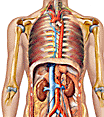
The nervous system is the body's control and communication network, gathering information, processing it, and coordinating responses. It allows a person to sense the world, think, move and regulate the internal workings of the body. The system is built from specialised cells called neurons, which carry signals as electrical impulses, supported by glial cells that nourish and protect them.
The nervous system has two main divisions. The central nervous system consists of the brain and the spinal cord, where information is processed and decisions are made. The peripheral nervous system comprises the nerves that branch out to the rest of the body, including the cranial nerves that emerge directly from the brain, such as the facial nerve, and the spinal nerves that connect to the limbs and trunk. Together these carry sensory information inward and motor commands outward.
Neurons communicate at junctions called synapses, where one cell releases chemical messengers known as neurotransmitters that influence the next cell. This signalling underlies everything the nervous system does, from reflexes to memory. The brain, the most complex organ, is organised into regions responsible for movement, sensation, language, emotion and higher thought. Sensory systems feed it information about sight, sound, touch and other stimuli. Many drugs act on the nervous system by altering how neurotransmitters work, which is why they can change mood, perception and behaviour.
Frequently asked questions
- What is the difference between the central and peripheral nervous systems?
- The central nervous system is the brain and spinal cord, where information is processed. The peripheral nervous system is the network of nerves connecting the rest of the body to the central system.
- What is a neurotransmitter?
- A neurotransmitter is a chemical messenger released by a neuron at a synapse to pass a signal to the next neuron or to a muscle or gland.
- How do neurons carry signals?
- Neurons transmit information as electrical impulses along their length, then pass the signal chemically across synapses to other cells using neurotransmitters.
|
|
Nervous system  related subject: Senses
 |
| Animated brain
animation |
| Brain: whole brain atlas
Normal aging: structure and function, Normal aging: coronal plane, Vascular
anatomy, Subacute stroke: loss of sensation, Chronic subdural hematoma,
Cavernous angioma, Neoplastic Disease (brain tumor), Degenerative Disease,
Inflammatory or Infectious Disease, Multiple sclerosis, AIDS dementia |
|
Brain
describes the brain, its structures, and function |
| Brain
Anatomy of the brain |
|
Brain The Brain, Lateral View, Sagittal View |
| Brain
anatomy brain anatomy |
| Brain atlas
brainatlas is your key to the whole range of outstanding brain atlases and
texts from the Paxinos laboratory, including the atlases of the developing
rat, the mouse, and the human brain |
| Brain atlas |
| Brain
and spinal cord brain basics, brain higher functions, spinal cord, peripheral nervous system, neurons
sensory systems, drug effects, neurological and mental disorders,
a tip |
| Brain
connection the brain and learning |
| Brain explorer |
|
Brain function and pathology |
| Brain icons |
|
Brain stem
The brainstem is the lower extension of the brain providing support and sitting
anterior to the cerebellum. It serves as a pathway for information to be relayed
between the brain and spinal cord and is composed of three structures including
the midbrain , pons , and medulla oblongata |
| Comparative mammalian brain collections
provides browsers with images and information from one of the world's largest
collection of well-preserved, sectioned and stained brains of mammals. Viewers
can see and download photographs of brains of over 100 different species of
mammals (including humans) representing 17 mammalian orders |
|
Cranial Nerves
describes the cranial nerves, their function, and origin/pathways when
applicable |
| Cranial nerves |
| Cranial nerves
the cranial nerves are 12 pairs of nerves that can be seen on the ventral
(bottom) surface of the brain. Some of these nerves bring
information from the sense organs to the brain; other cranial nerves control
muscles; other cranial nerves are connected to glands or internal organs such as
the heart and lungs, olfactory nerve, optic nerve, oculomotor nerve, trochlear
nerve, trigeminal nerve, abducens nerve, facial nerve, vestibulocochlear nerve,
glossopharyngeal nerve, vagus nerve, spinal accessory nerve, hypoglossal nerve |
| Cranial nerves
introduction to the structure and function of the human cranial nerves, cranial
nerves, anatomy, nervous system, nerves, gross anatomy, brain |
| Cranial
nerves tutorial the cranial nerves are composed of twelve pairs of nerves
that emanate from the nervous tissue of the brain. In order reach their
targets they must ultimately exit/enter the cranium through openings in the
skull |
|
Cranial nerves the 12 cranial nerves can be
divided into sensory, motor, or mixed nerves, part of
Neuroscience tutorial
Coronal and horizontal sections, Basic visual pathway, Basic somatosensory
pathway, Basic motor pathway, Eye and retina, Central visual pathways, Auditory
and vestibular systems, Somatosensory pathways from the body, Somatosensory
pathways from the face, Spinal motor structures, Brainstem nuclei of
cranial nerves |
| Cranial nerves
- introduction olfactory, optic, oculomotor, trochlear, trigeminal,
abducens, facial, auditory (vestibulocochlear), glossopharyngeal, vagus, spinal
accessory, hypoglossal |
| Effects of drugs on
the nervous system alcohol, amphetamines, caffeine, cocaine, heroin, inhalants, LSD, marijuana, nicotine, ecstasy, rohypnol, 1,4-butanediol, GHB, barbiturates, PCP, allucinogenic
mushrooms |
|
Genetics and the Brain |
|
Nervous System
The nervous system is the body's information gatherer, storage center and
control system. Its overall functions are to collect information about the
body's external/internal states and transfer this information to the brain
(afferent system), to analyze this information, ... |
| Neuroscience for
kids neuroscience, brain, nervous system, spinal cord, drugs, glia, sleep,
pain, development, neurology, neurobiology, cognition, perception, sensation,
biology |
|
Nerve1.ppt,
Nerve2.ppt,
Nerve3.ppt,
Nerve4.ppt ppt files |
|
Nerve Tissue |
| Nervous
system central nervous system, peripheral nervous system, micro anatomy |
|
Nervous
system The Neuron, The Nerve Message, Nervous Systems, Peripheral Nervous
System, Somatic Nervous System, Autonomic Nervous System, Central Nervous
System, The Brain, The Spinal Cord, The Brain and Drugs, Senses |
| Neurotransmitters and neuroactive
peptides Communication of information between neurons is accomplished by
movement of chemicals across a small gap called the synapse. Chemicals, called
neurotransmitters, are released from one neuron at the presynaptic nerve
terminal |
| Neurosciences on the
internet neurobiology, neuroscience, neurology, neurosurgery, psychiatry, psychology, cognitive, brain,
neuromuscular, Alzheimer, Parkinson, multiple sclerosis, muscular dystrophy, stroke, aplysia, drosophila,
neuropathy |
|
Neurotransmitters |
| Nerves
learn your nerves, cranial nerves |
| Pain and why it hurts |
|
Phenomena of human sleep summarizes the basic knowledge from the field of
sleep research. The emphasis is on the exploration of the rules of
polysomnographic recording and scoring sleep stages as well as on results and
opinions about the nature of sleep EEG, pdf file |
|
Protein synthesis animation |
| Reflex experiments |
|
Spinal cord: anatomy of the spine
the spinal cord is an extension of the brain. It is protected by
a bony structure called the vertebral or spinal column. The spinal cord is
covered with the same three membranes as the brain, the meninges. All the
information going from the brain to the limbs travels through the spinal cord.
This then allows for movement |
| The
brain and nervous system |
|
|
Home
|
Site Map
|
Email: support[at]karadimov.info
Last updated on:
2026-06-24
|
Copyright © 2011-2021 Educypedia.
https://educypedia.org
|
| |
|
|