| |
The Respiratory System
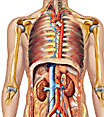
The respiratory system supplies the body with oxygen and removes carbon dioxide, the waste gas produced by cells. Air enters through the nose and mouth, where it is warmed, moistened and filtered, then passes through the pharynx and the larynx, which houses the vocal cords. From the larynx air travels down the trachea, or windpipe, which branches into two bronchi, one leading to each lung.
Inside the lungs the bronchi divide repeatedly into smaller tubes called bronchioles, ending in millions of tiny air sacs known as alveoli. The alveoli are surrounded by a dense network of capillaries, and their thin walls provide an enormous surface area for gas exchange. Here oxygen diffuses from the inhaled air into the blood while carbon dioxide diffuses from the blood into the air sacs to be exhaled. The oxygen is carried by red blood cells to tissues throughout the body.
Breathing is driven mainly by the diaphragm, a dome-shaped muscle below the lungs, together with the muscles between the ribs. When the diaphragm contracts and flattens, the chest cavity enlarges and air is drawn in; when it relaxes, the cavity shrinks and air is pushed out. This rhythm is regulated automatically by the brain, which adjusts the rate and depth of breathing in response to the level of carbon dioxide in the blood.
Frequently asked questions
- Where does gas exchange take place in the lungs?
- Gas exchange occurs in the alveoli, tiny air sacs surrounded by capillaries. Their thin walls let oxygen pass into the blood and carbon dioxide pass out to be exhaled.
- What is the role of the diaphragm in breathing?
- The diaphragm is the main breathing muscle. When it contracts and flattens, the chest expands and draws air in; when it relaxes, air is pushed back out.
- What path does air take to reach the lungs?
- Air travels from the nose or mouth through the pharynx and larynx, down the trachea, and into the bronchi and bronchioles before reaching the alveoli.
|
|
Respiratory system  |
|
Aerobic and
Anaerobic Respiration What is Aerobic and Anaerobic Respiration |
|
Alveoli and gas exchange alveoli and gas exchange, alveoli capillaries,
bicarbonate, carbon dioxide, carbonic acid, Hemoglobin |
|
Cellular respiration
The Point of Cellular Respiration, Types of cellular respiration, Aerobic
Respiration, Stages in Aerobic Respiration, Glycolysis, Kreb's cycle, Electron
transport phosphorylation, Role of oxygen in Aerobic Respiration |
|
Cellular respiration
Cellular respiration is the process in which the chemical bonds of energy-rich
molecules such as glucose are converted into energy usable for life processes,
... |
|
Cellular Respiration |
|
Cell Respiration Cellular respiration is the process by which the chemical
energy of "food" molecules is released and partially captured in the form of
ATP, ... |
|
Gas
exchange in the lungs Gas exchange in the lungs |
|
Lungs
the lung is composed of numerous sacs called alveoli. It is on the inner surface of the alveoli that oxygen is absorbed and
enters the bloodstream and carbon dioxide is released |
| Respiration
pdf file |
| Respiration
primary function is to obtain oxygen for use by body's cells & eliminate carbon dioxide that cells produce |
|
Respiratory anatomy & physiology respiration has two meanings in
biology. At the cellular level, it refers to the O2 requiring
chemical reactions that take place in the mitochondria and are the chief source
of energy in the eukaryotic cells. At the level of the whole organism, it
designates the process of taking in O2 from the environment and
returning CO2 to it |
| Respiratory
system the respiratory system is the system of the body that deals with breathing. When we breathe, the body takes in the oxygen that it needs and
removes the carbon dioxide that it doesn't need |
| Respiratory
system mouth, nose, trachea (windpipe), bronchi, bronchioles, alveoli (air sacs), pleural membranes, diaphragm, ribs |
| Respiratory
system heart, lungs, The Physiology of Breathing, The Upper Respiratory
Tract, The Nasal Cavity and Sinuses, The Ear, The Lower Respiratory Tract, The
Lobes of the Lungs, The Trachea, Bronchial Tubes and Aveoli, Cilia |
| Respiratory
system Breathing, External Respiration, Gas Transport, Internal
Respiration, Cellular Respiration, Structure of the Human Respiratory System,
The Nose, Pharynx and Larynx, Trachea, Bronchi, Bronchioles, Alveoli |
| Respiratory system
2 |
|
Respiratory system anatomy
The respiratory system is situated in the thorax, and is responsible for gaseous
exchange between the circulatory system and the outside world, ... |
|
Respiratory system and excretion system ppt file |
|
Respiratory System Color Images |
|
Thoracic viscera thoracic viscera, images |
|
|
Home
|
Site Map
|
Email: support[at]karadimov.info
Last updated on:
2026-06-24
|
Copyright © 2011-2021 Educypedia.
https://educypedia.org
|
| |
|
|