| |
Blood
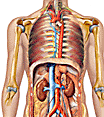
Blood is the fluid that circulates through the heart, arteries, veins and capillaries of the body, carrying oxygen, nutrients, hormones and waste products. It is made up of cells suspended in a pale yellow liquid called plasma. The main cellular components are red blood cells, which transport oxygen using the iron-rich protein haemoglobin; white blood cells, which defend the body against infection; and platelets, small fragments that help blood to clot and seal wounds. Plasma itself is mostly water and carries dissolved proteins, salts and other substances.
Human blood is classified into groups according to molecules called antigens on the surface of red cells. The best-known is the ABO system, which gives the blood types A, B, AB and O depending on which antigens are present, determined by a person's inherited genotype. A second important system is the Rhesus factor, which makes blood either Rh positive or Rh negative. These groups matter greatly for blood transfusions, because mixing incompatible types can trigger a harmful immune reaction. Knowing a person's ABO and Rhesus type ensures that donated blood is safely matched.
Blood tests are a common medical tool, used to examine the numbers and condition of blood cells, measure chemicals and proteins, and detect disease. The study of blood and its disorders is called haematology. The body also regulates blood production through signals such as the hormone erythropoietin (EPO), which stimulates the formation of red blood cells when more oxygen-carrying capacity is needed.
Frequently asked questions
- What are the main components of blood?
- Blood consists of plasma, the liquid part, plus red blood cells that carry oxygen, white blood cells that fight infection, and platelets that help blood clot.
- What are blood groups?
- Blood groups classify blood by antigens on red cells. The ABO system gives types A, B, AB and O, and the Rhesus system adds positive or negative, which together guide safe transfusions.
- Why are blood tests done?
- Blood tests measure cells, chemicals and proteins to assess health, diagnose disease, monitor conditions and check how organs such as the liver and kidneys are functioning.
|
|
Blood  related subject: Cells
 |
| ABO
blood group system, part of
Blood Group Antigen Gene
Mutation Database |
|
ABO Blood Types
There are four principal types: A, B, AB, and O. There are two antigens and two
antibodies that are mostly responsible for the ABO types, ... |
| Bloedgroepen bloedgroepen, rhesus factor,
transfusie met erytrocyten, bloedsomloop, bloedcellen, in
Dutch |
|
Bloedgroep, rhesusfactor en irregulaire antistoffen Bloedgroepen zijn
eiwitten die zich aan de buitenkant van de rode bloedcellen bevinden. Er bestaan
meer dan 200 soorten bloedgroepen. De meest bekende is de ‘gewone’ bloedgroep:
A, B, AB of O,
in Dutch |
|
Blood |
| Blood |
|
Blood |
|
Blood general overview This leaflet describes blood and how blood cells are
made. It give brief overview of common blood disorders,
pdf file |
| Blood
blood types, blood components, blood groups, blood, human, red cell, white
cell, plasma, platelet, erythrocyte, hemoglobin, leukocyte, thrombocyte,
protein, agglutinate, agglutination, antigen, antibody, recognition-rejection,
Landsteiner, blood type, ABO, Rh, universal donor, universal receiver, genotype,
phenotype, Bombay phenotype, HLA, mother-fetus incompatibility,
erythroblastosis, anemia, blood test |
| Blood
cells blood consists of a suspension of special cells in a liquid called
plasma. In an adult man, the blood is about 1/12th of the body weight and this
corresponds to 5-6 litres |
| Blood
chemistry definitions blood chemistry definitions, blood tests, hematology,
liver enzymes, mean corpuscular volume, ... |
|
Blood
group antigen gene mutation database the BGMUT database of variations in
the genes that encode antigens of blood group systems |
| Blood group antigens
Blood group antigens are the molecules expressed on the surface of human red
blood cells (RBC), against which antibodies occur naturally or can be raised.
The most popular blood group antigens of clinical importance are the
blood-group-ABO antigens and Rh antigens, what are Blood group antigens,
Blood Group Antigens and Cell Adhesion |
|
Blood types
Blood types |
|
Blood types
Animated Blood Types, Blood Factor Explanation, Determining A-B-O Blood Types,
Blood Agglutination By Antibodies |
|
Blood vessels
blood vessels are intricate networks of tubes that transport blood throughout
the entire body |
| Blood vessels
arteries, which carry blood away from the heart at relatively high pressure,
veins, which carry blood back to the heart at
relatively low pressure, capillaries which provide the link between the arterial and venous blood vessels |
| Blutgruppen
in German |
|
Erythropoietin - EPO |
|
Genes and blood type
the components of blood, the proteins that determine blood type, and how
transfusion (sharing) of blood between people is possible |
|
Hematologie in Dutch |
| Hematology
free online book |
| Hemoglobine
bloedplasma en bloedcellen, bloedplasma, witte bloedcellen, rode bloedcellen (=erythrocyten), witte bloedcellen (=leucocyten), bloedplaatjes (=trombocyten), in Dutch |
| Hemoglobins
what are Hemoglobins |
|
Human Blood Types
Reference Human Blood Types Reference, O Positive, O Negative, A Positive, A
Negative, B Positive, B Negative, AB Positve, AB Negative |
|
Plasma cells B lymphocytes (often simply called B cells) and, T lymphocytes
(likewise called T cells) |
|
Rhesus factor
Rhesus factor, Rh Blood Group System, Antigens of the Rh blood group system are
products of RHD and RHCE (collectively referred to as RH30 or RHCED), two
tightly linked and highly homologous genes, ... |
|
Rhesus factor
Rhesus factor, A gene, B gene, O gene, Blood Antigen Diagrams,
pdf file |
|
|
Home
|
Site Map
|
Email: support[at]karadimov.info
Last updated on:
2026-06-24
|
Copyright © 2011-2021 Educypedia.
https://educypedia.org
|
| |
|
|